Urban History | Shuangyu: Looking for "Shanghai in the 16th Century"
In April 2017, I went to Zhoushan to look for the legendary "Shuangyu", the world free trade port called "Shanghai in the 16th century" by historians, to explore the positive encounter between China and marine civilization 500 years ago.
Half a century after Zheng He’s voyage to the West, Columbus and Da Gama stepped onto the historical stage, and the world has undergone tremendous changes. The great voyage expanded the network of European civilization from the Mediterranean to the Atlantic Ocean and the Indian Ocean. Portuguese, Spanish and Dutch crossed the Straits of Malacca and crossed the Pacific Ocean to East Asia, forming an international trade corridor between Nagasaki in Japan, the southeast coast of China and Manila in the Philippines, which is what Japanese historians call "Ocean Asia". The southeast coastal area of China, which participated in this international trade, has formed a "China of the Sea" which is different from the inland culture in the north. The civil forces engaged in maritime trade have been suppressed by the government and are stigmatized as "the enemy" in the history books. In 1548, the Ming government sent troops to wipe out Shuangyu, the center of the world trade of the Japanese pirates, which was a landmark turning point in the fate of "Ocean China" in the era of great navigation.
Where is "Shanghai in the 16th century"?
The record of "Shuangyu", Ji Guang Pian Yu, can generally be traced back to the Journey written by Portuguese Jesuit priest Fernand Mendes Pinto published in 1614. Pinto described how the Portuguese established a "town hall", a Catholic church and a hospital on Shuangyu Island, with a population of 1,200. Maritime groups from China, Japan and Southeast Asia all went to Shuangyu Port for trade, forming an international trade port.
According to China’s Ming History, in the twenty-seventh year of Jiajing (AD 1548), on the eighth day of April, Zhu Wan, the governor of Zhejiang Province, led 6,000 Ming troops and 380 warships, defeated the enemy in Shuangyu at one fell swoop, burned warehouses and cargo ships, and captured the maritime business leaders Li Guangtou, Xu Liu and Yao Da.
We plan to fly to Ningbo airport first, rent a car and take a ferry from Guoju Port in Beilun to Liuheng Island in Zhoushan, and then take a walk along the northwest side of the coastal island by car, looking for the clues of Shuangyu in the past on the coastline facing Fodu Island.
The name of the car ferry happens to be "Shuangyu". After sailing, I have been standing on the deck, looking for the surrounding area where is the artillery mountain of Meishan Island, where is Fodu Island, Liuheng Island and Shuangyu Island according to the GPS map. A young staff member on the ship chatted with me. He is a six-legged man, but he didn’t grow up on the island since childhood and returned to Zhoushan after studying. Few people in his generation stayed on the island, and most of them went out to "run boats" and do business. Young people said that now Liuheng has introduced some enterprises and the economy has developed, but the imported enterprises will also cause pollution. Young people seem to pay more attention to environmental quality.
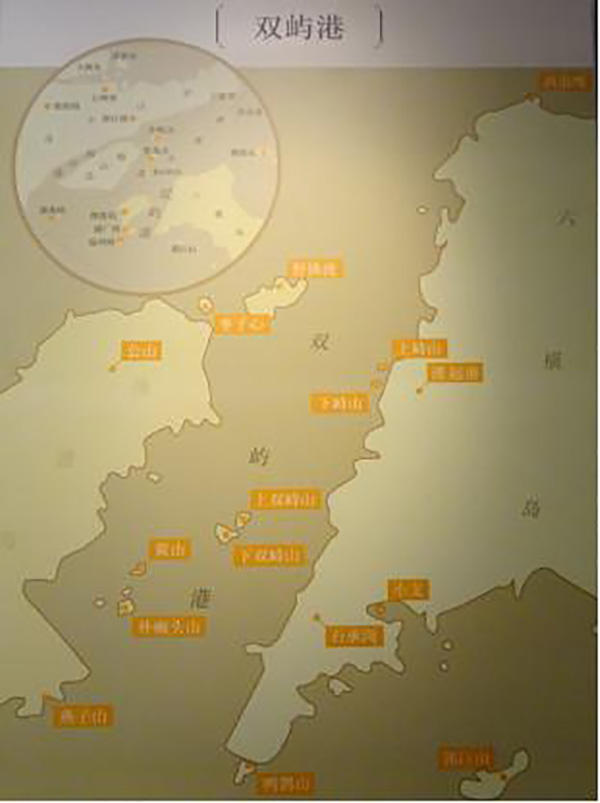
Map of Shuangyu Port. The pictures in this article are provided by the author.
The Shuangyu ship is walking on the sea, and the surrounding islands seem to be connected by mountains and seas, so it is difficult to distinguish each other. Occasionally, looking between the two mountains, you can vaguely see a row of gantry cranes. It seems that Zhoushan Islands have entered the stage of heavy chemical industry. Less than an hour’s journey, the "Shuangyu Ship" docked at Sha ‘ao Port in Liuheng Island.
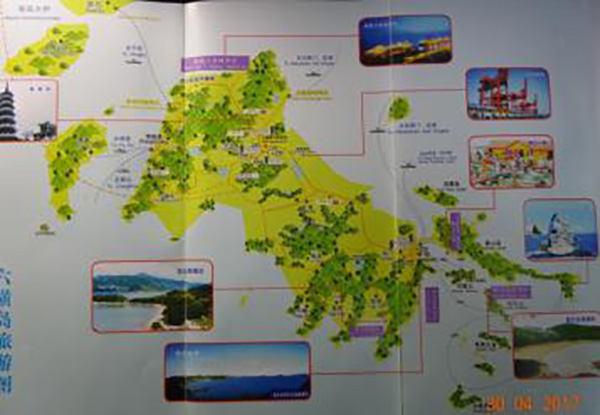
Map of Liuheng Island
From the map, Liuheng Island looks like the Korean Peninsula. It lies on its back in the southeast sea of Beilun, Ningbo from northwest to southeast, and the surrounding water depth is slow, making it an ideal natural harbor. Just as the Korean peninsula is divided into "north and south", Liuheng is also divided into Shangzhuang and Xiazhuang. There are three ports from west to east on the coastline equivalent to the "China-DPRK border" in the north, namely, Zengqi Port, Sha ‘ao Ferry Terminal and Da ‘ao Passenger Terminal; There is also a port in the south equivalent to "Busan", which is Taimen Wharf. The ferry from Guo Ju to Sha ‘ao runs every hour, and the passenger liner from Da ‘ao to Dinghai is also frequent. The waiting hall in Da ‘ao is large, but the berths in the wharf are less than those in Sha ‘ao, because there are mainly passengers here, and there are only four car ferries every day.
The legendary Shuangyu is located between Liuheng Island and Fodu Island. However, Liuheng Island is an ordinary island. From the water traffic at the township level, it is impossible to imagine "Shanghai in the 16th century".
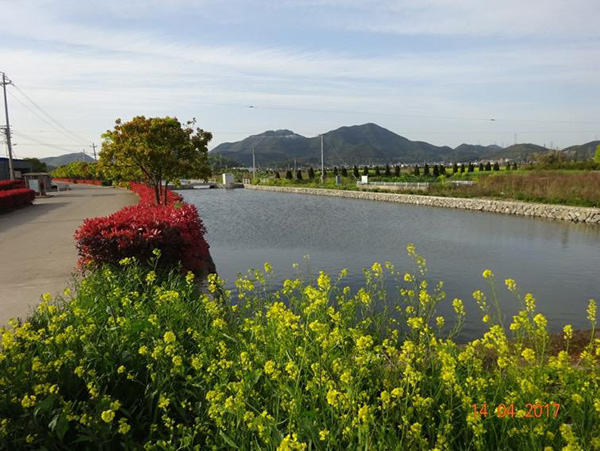
The scenery of Liuheng Island
The roads on the island are of high grade and the roadside greening is beautiful. There are few vehicles along the way and the air is fresh, which is very suitable for self-driving. Passing villages are often colorful and clean. The neat dams built along the coast show that there is also a danger of flooding on the island at high tide. However, the path leading to the seaside often runs between farmland, ponds and villages, and occasionally there are large areas of land reclamation outside the seawall, which seems to be preparing for the large-scale introduction of industrial projects.
We came to a small village called "Zengqi", which is the nearest fishing village in Liuheng Island to Fodu Island. The bus stop sign says "Zengqi Port Pier", and the house number is "Zengyu Hangchuan Wharf Road". There are ten rooms and nine empty rooms in the small village, the doors of the houses are closed, there is a waiting hall at the entrance of the village that goes straight to the dock, and the ticket window is closed. It seems that tickets have not been sold for a long time.
There is a gap in the dam between the waiting hall and the dock for driving, and there are several deep grooves on both sides. It seems that it is used to add boards to stop the tide when the tide is high, indicating that this port and fishing village are really in danger of being swallowed up by the high tide. Standing on the dock and looking in the direction of Fodu Island, the sea surface narrows here and looks more like a wide river. Is this the legendary "Shuangyumen"? I later learned that "Zengqi" is the legendary location of "Shuangyu", and the water depth here can reach 70 meters.
Why do honest officials lie about military intelligence?
If I hadn’t personally stood in Shuangyu Port, the nearest place between Liuheng and Fodu Island, I wouldn’t have questioned the record in Ming History: the Ming government troops "built a wooden stone to plug Shuangyu Port and returned it, but those who arrived after the ship were not allowed to enter". According to my visual observation, it is absolutely impossible to "plug" this wide sea with wood and stone, and the surrounding islands are numerous and the navigation channel is like a maze. Even if Shuangyu Port can be "plugged", "Fanbo" can be parked everywhere. In my opinion, the source of this record in the history book is that the frontline generals are lying about their military situation.
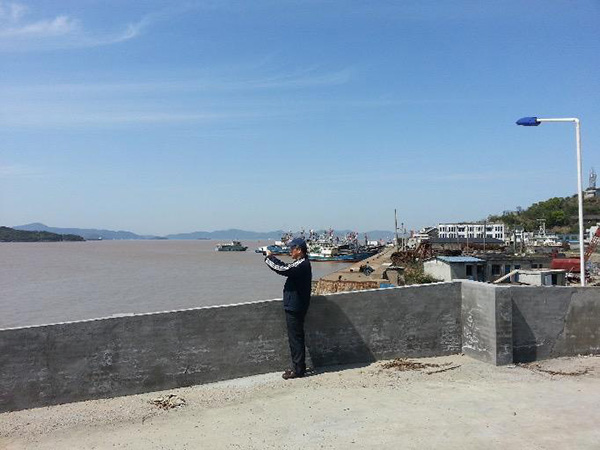
"Shuangyu Port" in those days
The authors of Ming History, like Emperor Jiajing, sat in the imperial court in Beijing, having no idea of the situation on the front line of the southeast coast. They relied on the battle report of the front line to imagine the brilliant record of wiping out the Japanese pirates. And the front-line officials, even honest officials like Zhu Wan, are also trying to figure out the holy will and blatantly fabricating the battle report to invite merits and rewards.
There is only one thing at the scene that can be confirmed by historical books, that is, this "Shanghai in the 16th century" was indeed completely destroyed. We can’t see any traces of ports and towns on Liuheng Island. The two temples on the island were built in the Qing Dynasty. On the wall of a temple by the sea, there is a cliff stone carving "The First Merit of East Zhejiang", which was built by local militia to fight against the Taiping Heavenly Kingdom during the Tongzhi period of the Qing Dynasty. I’m afraid this meritorious service was also evaluated by the battle report played locally.
It can be said that judging from the ground remains, the history of Liuheng Island only began in the Qing Dynasty. If it weren’t for industrialization in recent years, Liuheng would be a remote island that stayed in agricultural and fishery production and had nothing to do with the outside world. "Shanghai in the 16th century" is purely said by Li Shuyan.
Why lie about military intelligence? Because after the battle of Shuangyu, Zhu Wan wanted to set up a camp in Shuangyu. One argument is that people who make a living from the sea strongly opposed it, and the other is that officers and men from Fujian are unwilling to station in Zhejiang Island. So he failed to station troops, and reported that he had blocked the port with wood and stones and made a job.
There was nowhere to go at night in Liuheng Island, so I opened Takeo Tanaka’s The Enemy. Before him, the Japanese were educated that the Japanese pirates were "brilliant overseas development of the Japanese". After careful study, Tanaka found that it is impossible to understand the problem of the enemy with the land-centered historical view. If we take the "view of history centered on the ocean that is not bound by national boundaries", we will find that the problem of the enemy is not only the history on the sea, but also the history on land; Not only Japanese history, but also the history of Ryukyu, Korean Peninsula and China, and even the history of the whole world.
In the section of "Destruction of Shuangyu Port", Zhu Wan described by the author is an honest and upright bureaucrat, who was instructed by Emperor Jiajing to be the governor of Zhejiang and the prefect of Zhejiang and Fujian sea lanes. He knows very well that the smuggling trade and pirates are behind the coastal squires and bureaucrats, and cracking down on the pirates will inevitably violate the vested interests of the coastal areas: "Stealing foreign countries and stealing China; It’s easy to be a thief in China Binhai, but it’s hard to be a thief in China. "
He has seen clearly that behind the smuggling ring is the collusion between the central and local bureaucratic forces. He is a firm official who will never give in to the smuggling forces. From the standpoint of the government, he regards the businessmen smuggling along the coast as "thieves". From the perspective of his ethical education, it is necessary to "suppress" the "thieves".
When he took office as governor of Zhejiang in 1547, Emperor Jiajing instructed him that smuggling trade activities in Zhangzhou, Quanzhou, Ningbo, Shaoxing and other places in Fujian were left unchecked, and ordered him to take charge of military affairs of pirates such as Fuzhou, Xinghua, Jianning, Zhangzhou and Quanzhou. Zhu Wan immediately rushed to Fujian under the imperial edict, blocked maritime traffic, demolished ships with more than two masts, and severely cracked down on smuggling activities. In April, 1548, Zhu Wan ordered Lu Tang to command the Ming army to attack Shuangyu, captured two Japanese alive, burned down more than 10 Tianhou Palace and more than 20 houses, and "there are countless thieves and dead people", and buried wood and stones to block the port. Obviously, this is no longer anti-smuggling. Zhu Wan not only arrested and killed people, but also set fire to houses and temples. This is an official beating, smashing, looting and burning.
A "honest and upright" bureaucrat can burn and kill excessively, and he can lie about his military situation, from which he can get a glimpse of the darkness and disorder of the whole administrative system in the Ming Dynasty.
Why are history books systematically falsified?
It is a concrete lie to block Shuangyu Port with wood and stone, and the "Japanese pirates" rebellion is a systematic fraud. Many cliff stone carvings along the coast of China, whether "there is no wave in the sea" or "there is no wave in the sea", are all telling stories of "resisting Japan" and "calming Japan". But the true stories behind these legends were covered up by the "anti-Japanese" lies of official history compilation.
The closed-door policy in the early Ming Dynasty was changed during Yongle period, allowing Japan to do formal trade with China. This trade was controlled by the imperial court of China in terms of scale and frequency. In 1523, two Japanese merchant ships came to China, and China’s foreign trade department accepted bribes, which changed the order of Japanese merchant ships in courtesy and triggered a "battle for tribute". The Ming Dynasty’s response to this was not to trace corruption, but to remove the lock of the shipping company, which made the trade between the two countries forced to be smuggled in fact. Destroying Shuangyu was Zhu Wan’s purpose to suppress smuggling.
In his book, Takeo Tanaka cites the careful statistics of Daobo Ishihara. There are more than 200 names of "Japanese pirates" in China’s historical materials, such as "real Japanese pirates", "fake Japanese pirates", "Japanese slaves" and so on, but the research result of Takeo Tanaka is that "in the final analysis, the main body of Japanese pirates is Chinese"; The smuggling trade between China and Japan is not governed by the rule of law, and the contradictions between them are complicated. The result of the government’s extermination is to force businessmen to be bandits.
After Shuangyu was razed, Zhejiang-Fujian maritime armed trade forces moved from north to south to Fujian, Guangdong and Southeast Asia. Zheng Chenggong was a hero who left a great legacy for the Chinese nation in this group. Why are private maritime merchants who practice openness stigmatized as "pirates"? Why can this distorted history be passed down from generation to generation?
It turns out that the History of the Ming Dynasty is the history of the Qing Dynasty, and it takes the longest time in the history of China. It took more than 60 years from Kangxi to Qianlong. How to judge the history in the middle must refer to the needs of the imperial court at that time. The "contemporary" basis of the anti-Japanese narrative in Ming History is obviously the ban on the sea during the Kangxi period. It can be seen that as long as there is a saying of "the enemy" in the history books, the deep place of national discourse is still the mentality of forbidding the sea and locking the country.
"The Qing empire was self-sufficient in vast territory and abundant in resources, foreign businessmen were unscrupulous in their designs, and the troubles in China were caused by others’ intrusion, and a wise monarch was able to resist foreign aggression and eliminate violence," and the historical discourse of the Japanese pirates and Hirawa accorded with this whole set of rhetoric to the greatest extent.
In fact, Zhu Wan is not without feelings for the unpopularity of the government. He found that the common people were greedy for the "enemy", but avoided the government troops. At that time, 90% of the livelihood of Fujian coastal residents was related to maritime trade. On the one hand, the imperial court ignored the orders of people’s livelihood, on the other hand, it was the reality of coastal society. Zhu Wan chose to carry out the orders, which determined his tragic fate. No wonder, after the destruction of Shuangyu Island, the gentry and bureaucrats in the coastal areas of Zhejiang and Fujian participated in the impeachment of Zhu Wan in succession. The emperor’s balance tilted towards powerful vested interests, and Zhu Wan was taken away from his official position and recalled to Beijing. He did not want to be humiliated and committed suicide.
In the civilized body where corruption is accelerating, all the sacrifices of "saving the day from falling" are just to keep the dying dynasty alive, and the ideal of all loyal officials and Confucian businessmen, Hwa-Sung Do, is nothing but a paper horse. If Zhu Wan is a tragic loyal minister, Wang Zhi is a tragic Confucian businessman.
Shortly after Shuangyu Port was leveled, the real protagonist in the history of "Japanese pirates" appeared, that is, Wang Zhi, an Anhui businessman who escaped from Shuangyu. According to historical records, Wang Zhi is not a courageous and foolhardy pirate, but a courageous and resourceful businessman with elegant temperament. He first moved the place of maritime trade to the northern part of Shuangyu (which also proved Zhu Wan’s false report on military intelligence), and then retreated to Hirado, Nagasaki, Japan, under the encirclement and suppression of the Ming government. Matsuura Takashin, the Lord of Hirado, accepted Wang Zhi to strengthen overseas trade. The arrival of Wang Zhi made Hirado increasingly prosperous, known as the "West Capital", and Wang Zhi was also known as the "King of the Enemy".
Wang Zhi was far-sighted and saw the great opportunity of maritime trade. Trade and mutual market not only brought prosperity to coastal areas, but also greatly benefited the whole country. But this Confucian-educated "Mr. Wufeng" gambled his hopes and life on the Daming court, which was against the trend of the times.
On the one hand, Hu Zongxian, the left assistant minister of the Ministry of War of the Ming Dynasty and the governor of Zhejiang Province, ordered Qi Jiguang to "ambush several rounds of the generals, and the key points of land and water are dotted with fish and birds." At the same time, he was kind to Wang Zhi’s family and promised to trade with Wang Zhi, so Wang Zhi surrendered to the government and returned to Zhejiang.
However, the two propositions of "switch" and "lock the country" in the Ming Dynasty were at loggerheads. In December 1559, Hu Zongxian beheaded Wang Zhi as the leader of the "enemy" because he wanted to clear up the rumors that he had taken bribes from Wang Zhi. It is said that Wang Zhi lamented before his death: "If I die alone, I will be afraid of suffering the people of Zhejiang." A fierce man, who is in charge of the sea, failed to stand out from the corrupt Ming Dynasty in the booming ocean Asia, but entrusted his fate with the "people of Zhejiang and Guangdong" to the court, which is a typical tragedy of Confucian businessmen in China.
Both Zhu Wan and Wang Zhi were born in the era of great navigation. Emperor Jiajing, on the other hand, rejected the opportunity of this era, and as a result, he forced businessmen to be bandits. People who live along the coast make a living by foreign trade, and the result of closing to the outside world is to deprive maritime businessmen of their way of life. This is the real reason for the so-called "enemy’s disaster". The "invasion of the enemy" finally subsided, not by strengthening the maritime ban, but by partially lifting the maritime ban after Emperor Qin Long ascended the throne in 1567. This proves Wang Zhi’s proposition from the opposite side.
The tragedy of loyal officials and Confucian businessmen is not only the tragedy of an era, but also the tragedy of the whole closed civilization. It is impossible for a closed civilization to open up by its own efforts, and independent opening up is often a stopgap measure. When the country once again chooses to close its doors to the outside world, both loyal officials and Confucian businessmen can’t get rid of the tragic fate. In a civilization that goes against the historical trend, it is not surprising that sentimental businessmen believe in the imperial court and commit themselves to the country, not only losing their lives, but also tarnishing their reputation, which has not been washed for 500 years.
The sea is moody, and "Shanghai" is hard to meet.
The next day, we went to Dinghai from Liuheng Da ‘ao Wharf. When we arrived at Da ‘ao Wharf, we saw crowds of outsiders in the waiting hall, because several passenger ships had just stopped because of the fog. We finally got on the 10 o’clock passenger ship. Soon after sailing, the bow direction was already foggy. When I walked onto the deck, I couldn’t see anything around except the waves not far from the hull and stern. The fog really gives us a taste of the moody temper of the sea.
The boring queue time gave me unexpected gains. The boss surnamed Zhou, who ranks first, is a native of Liuheng. He used to work in a shipyard, but now he works in facility agriculture. He is very talkative.
He said that there used to be 13 townships on Liuheng Island, which were merged into one town 10 years ago, and the foreign resident population was nearly 100,000. Industry is developed in the north and agriculture and tourism in the south. The infrastructure is well built to attract investment, and both power plants and COSCO are attracting investment. The air quality of Liuheng ranks second in China and first in Zhoushan.
According to boss Zhou, Liuheng seized the opportunity in this round of reform and opening up: in the early 1990s, Liuheng’s shipbuilding industry was very prosperous. At that time, young people all entered the shipyard, first building small steel fishing boats and then repairing big ships. At present, there are three shipyards on Liuheng Island: COSCO, Xinya and Longshan. COSCO is a central enterprise and the other two are private enterprises. Another big enterprise is Zhejiang Electric Power. Repairing the ship pollutes the water and needs to be treated. There is no pollution in the power plant in theory, but it depends on whether the environmental protection equipment is used normally.
For the next development, Liuheng is also reclaiming land from the sea. He pointed to the map on the wall and said that under the word "six" was the location of land reclamation now.
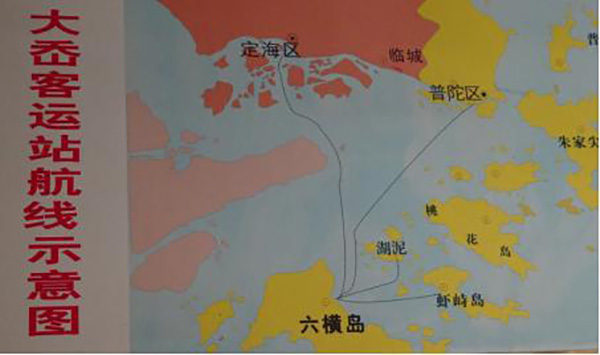
Schematic diagram of the route of Da ‘ao Passenger Station
The authentic Liuheng man confirmed that "Shuangyu" is the sea surface between Zengqi Port and Fodu Island. He said that the water depth there can reach 70 meters, and his grandfather once caught city bricks when he was fishing in Shuangyu area. Liuheng people call the Japanese pirates "red hair" and Liuheng people call potatoes "red hair sweet potatoes". "Foreigners’ graves" have been found in many places on the island, which were the graves of foreigners hundreds of years ago. There is a "Liuheng Folk Museum" in Li ‘ao Village, which was built by a retired teacher, Mr. Yu. After retirement, the old man devoted all his energy to sorting out the history of Six Horizons. At the age of 80, he finally built a museum and died in his 90s. Now some old cadres and teachers in the town have formed a team to study and compile the Liuheng Town Records.
The official has an official history, and the people have a folk history. That is the custom that oral communication cannot establish words. For example, the ban on moving people by sea is an unquestionable imperial edict in official history, but there is another story circulating among Liuheng people: Liuheng Island has experienced two large-scale bans on moving people by sea, the first one was in the anti-Japanese period of the Ming Dynasty, and the second one was in the early years of the Qing Dynasty, that is, the period when Zheng Chenggong occupied Taiwan Province.
In order to cut off Zheng Jun’s supplies, the Qing court imposed a strict ban on the sea in the southeast coast, and the people on the island and along the coast left their homes and moved inland. However, there are 13 people on Liuheng Island who stayed on the island against the imperial ban. They are called "thirteen grandmothers" by the people and regarded as the common ancestor by Liuheng people. There is no ancestral temple or temple for thirteen old ladies on Liuheng Island, and they are enshrined in the hearts of islanders.
On Liuheng Island, thirteen old ladies are sacrificed on holidays, weddings and funerals. During the Spring Festival, every family should clean up the hall and offer a sacrifice to thirteen old ladies after the Guanyin ceremony. Six horizontal points are Shangzhuang and Xiazhuang, where six old ladies are sacrificed in Shangzhuang and seven in Xiazhuang. The spirit of "thirteen old ladies" is the spirit that coastal people yearn for freedom and the sea. I wonder how the future "Liuheng Town Records" will record the history of "thirteen old ladies".
We went ashore from Dinghai to visit Zhoushan Museum. The culture of Zhoushan Islands has the characteristics of marine culture. When the baby boy is full moon, the fisherman will put him on the beach with a big wooden basin to "know the water". It is said that this can improve the affinity between the baby and the sea and better adapt to life at sea in the future.
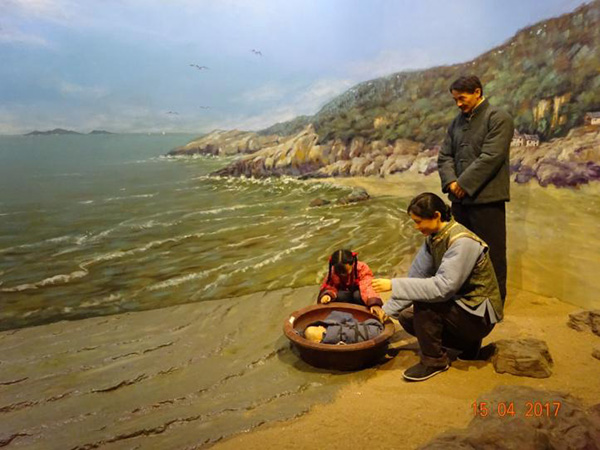
Zhoushan museum, baby boy "knows water" at full moon.
People living along the coast have a tradition of sailing since ancient times, but until the era of great sailing, the navigation of all ethnic groups was local, regional and relay. For example, in the Song and Yuan Dynasties, China’s large sailboats often traveled to and from India, and they were connected with Indian and Arabian fleets to form the Maritime Silk Road.
However, the 16th century opened the era of global ocean integration, and the innovation and diffusion of human civilization entered a state of accelerated circulation. In 1522, Magellan’s fleet completed its voyage around the world; In 1543, Wang Zhi, a China maritime merchant, led the Portuguese to Japan. In 1565, the Spanish arrived in the Philippines, where Chinese was doing business. On the whole ocean of East Asia, China’s maritime merchants competed with the world, jointly established the framework of maritime Asia and entered the global competition and exchange network.
Ocean China continued to go south under the official clearance, and settled in Fujian and Guangdong provinces. Since then, South China University of Technology went abroad, the hometown of overseas Chinese, and China’s "eight great men of overseas colonization" all came from Fujian and Guangdong. Even Liang Qichao said that when Chinese civilization expands to the world in the future, "people in these two provinces can still be used."
Calling Shuangyu "Shanghai in the 16th century", the speaker regrets that this international trade center, which combines favorable conditions and favorable conditions, was strangled by the mainland empire. In fact, the emergence of this "Shanghai" under the rule of the Qing Empire was a rare event. Even without Zhu Wan’s clean-up, it was impossible to build a real "Shanghai" only by the ideas and technologies of the Portuguese, Japanese and China maritime pirates at that time.
First of all, from the court’s point of view, Zhoushan is the tax source of the mainland empire. Since the Spring and Autumn Period, Guan Zhong of the State of Qi, in order to extract industrial and commercial taxes equally among the people, the imperial court monopolized the salt producing areas by the government by means of "salt and iron official camp", and the people consumed salt with heavy taxes between meals, which virtually assumed the tax burden for the imperial court.
Zhoushan is one of the top ten sea salt producing areas along the coast of China, so the history of the struggle between government monopoly salt field and private salt trafficking is endless. In Zhoushan Museum, the penalties imposed on smuggling salt in the past dynasties were exhibited. For hundreds of years, selling smuggled salt ranged from tens of kilograms to several kilograms, and all of them were at the risk of decapitation. How can a special customs territory like Shanghai be allowed to appear?
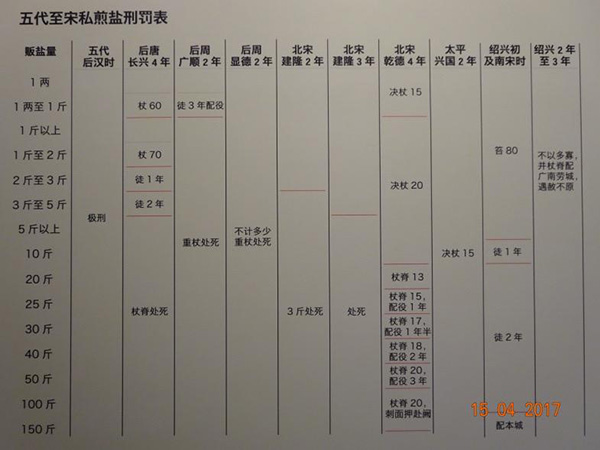
Penalty table for privately cooking salt from the Five Dynasties to the Song Dynasty
From the perspective of administrative jurisdiction, Zhoushan’s position has risen and fallen several times, which depends entirely on the judgment of the mainland empire on the value of the island. In 738 AD (the 26th year of Tang Kaiyuan), the court established Wengshan County here because of salt tax. In 1278 (15 years from the Yuan Dynasty to the Yuan Dynasty), because of its "sea route and dangerous place" and "household registration doubled", the county was promoted to a state; In the early Ming Dynasty, in the name of "an island in an isolated county, which is prone to bandits", the court moved more than 30,000 islanders from 46 islands inland, leaving only two thousand households. No matter Tang Xing, Yuan Sheng and Ming Decline, Zhoushan is not alone overseas, but firmly in the hands of the imperial court. How can there be an "adventurer’s paradise"?
From the general trend of globalization, Zhoushan is backed by the rich hinterland of the south of the Yangtze River and can reach the Grand Canal, the economic center of China, which is in a key position for China to communicate with the world. Shuangyu is the first choice for China to build a free trade zone, because its water depth is slow and it keeps a certain distance from the land control. However, Shuangyu was razed in the Ming Dynasty. After Fujian, Zhejiang Province "flattened Japan", in 1554, the Portuguese obtained the official permission to trade in Guangzhou. Three years later, they were allowed to live in Macau for their contribution to suppressing China’s mutinies. If Shuangyu survived, it would be just "Macau in East China" and could not be "Shanghai".
Two hundred years after Shuangyu was razed, the historians of the Qing Dynasty reiterated the same position of the Ming government to ban the sea in Ming History. Another hundred years later, the innovation center of human civilization has shifted from Portugal and the Netherlands to Britain, which completed the industrial revolution, and knocked on the door of China with treaty of nanking. This time, three hundred years after Shuangyu was leveled, the world in the sea power era pushed Shanghai to the conservative and arrogant Qing Dynasty.
China history books call the concession "a country within a country". Translated as "Ministry of Industry Bureau", the English name of Shanghai British Concession Administration is The Municipal Council. Its governance can be traced back to ancient Greece, Rome and Renaissance Venice and Amsterdam.
Venice is both a city and a country, and it has been a republic for thousands of years. When the banks, bills of exchange, patent law and double-entry bookkeeping invented by Venice crossed the Alps and reached northwest Europe, Amsterdam was the "sea coachman" in the world. The Dutch used their reputation to open up the trade between the East and the West, and then handed over the baton to the British Empire, which integrated scientific revolution, religious revolution, commercial revolution and industrial revolution.
At the same time, humanism from the Renaissance began in France, and a series of great thinkers awakened the humanitarian feelings of the western world. Literature and art, based on caring for people’s fate and suffering, came to Shanghai together with British and American liberal culture through Republican politics after the Great Revolution. The two cultures of Britain and France jointly challenged China in Shanghai, and Jiangnan, a place where Chinese civilization gathered, was the one to fight.
As a result of challenges and challenges, "Shanghai has not lost itself like other colonial cities in the world, although it is mixed with foreign countries." This cosmopolitan city in China is also the place where the national consciousness was awakened the earliest and the revolution was mobilized the most widely. It has built a platform for the exchange of ideas between the East and the West, bringing together and accommodating all kinds of new things. The Communist Party of China (CPC) was born here ".
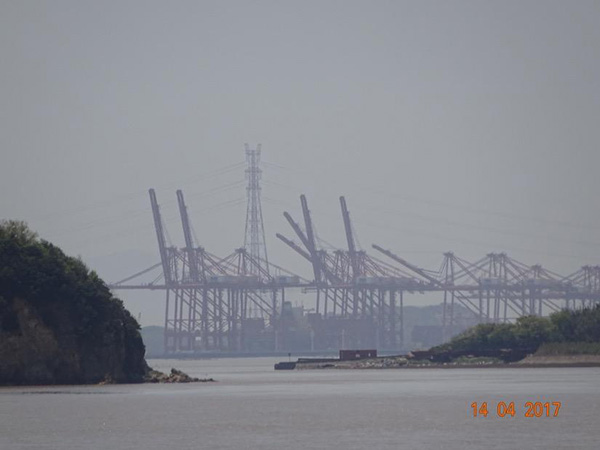
Heavy industry near the sea
We enjoyed delicious seafood in shenjiamen and drove back to Ningbo along the cross-sea bridge. From time to time along the way, you can see the heavy chemical industrial zone near the sea, dense power grids, oil tanks and chimneys. China now ranks among the best in the world in terms of power generation, chemical production, steel production and shipbuilding, but this trip has not brought me a relaxed mood.
After 500 years, it seems that we have lost more than just Shuangyu. We are still telling lies in history books. We have not reviewed the rise and destruction of Shuangyu from the perspective of civilization progress, and we have no courage to clear the name of the maritime merchant who was stigmatized as "the enemy" in that year.
Therefore, every few years, there will be a vicious recurrence of "forbidden sea diseases" such as "boycotting Japanese goods" and "boycotting American goods". Will we let future generations look for historical sites that are more regrettable than "Shanghai in the 16th century" on the road of human civilization?
references
1. Xiao Chunlei’s "The Enemy, the Lie of a Dynasty" chinese national geography, No.02, 2012
2.[ Japan] Takeo Tanaka and Yang Hanqiu translated "The Enemy-Maritime History" Social Science Literature Publishing House
3. "Biography of Ming History 93: Biography of Zhu Wan Zhang Jing Hu Zongxian Cao Bangfu Li Sui Tang Shunzhi"
4. Wang Wenhong’s Shuangyu Port: the earliest free port in the world-the description of Shuangyu Port in Portuguese Pinto’s Travel Notes.
5. Shen Kuanyan Xie Guoping’s "Zhoushan Liuheng Shuangyu Port was a global trade center 500 years ago"
6. Baijil (France) "History of Shanghai: The Road to Modernity"