Digital governance, how to "borrow speed to heat up" public services
In recent years, digital technologies such as big data, blockchain and artificial intelligence have developed rapidly. Some digital technologies are deeply integrated with smart urban and rural construction, and application scenarios are constantly expanding, which has become an important support for public services. Digital technology has the advantages of fast iteration speed, high intelligence level, wide application range, low marginal cost and easy scale promotion, which greatly improves the level of generalization, efficiency and convenience of public services. We should continue to tap and give full play to the potential of digital technology, better meet the public service needs of the broad masses, and strive to build a solid foundation for people’s livelihood in promoting Chinese modernization.
Install digital technology "wings"
In essence, public service is the interaction and cooperation among government, market and social subjects around public products. Digital technology has the characteristics of digitalization, fast iteration and innovation superposition, which can speed up information flow and sharing, promote the reconstruction of management processes and greatly optimize and upgrade the public service system.

Digital China Theme Exhibition Area of ICIF Xinhua News Agency/Photo courtesy
Digital technology expands the extension of public services. Traditional public service refers to the one-way process of production and supply in public sector and passive consumption by the masses. In this process, it is often difficult for public departments to know the service needs of the masses in time and accurately, and it is also difficult to quickly perceive the experience and satisfaction of the masses. Digital technology has brought great changes to this public service model. Technologies such as the Internet, big data and cloud computing enable relevant departments to better obtain and manage a large amount of data and information, and more comprehensively and deeply understand and solve the public service needs of the masses. For example, in the construction of smart communities, the needs of the elderly, children, the disabled and other groups such as life, medical care, rehabilitation and nursing can be quickly transmitted through digital facilities, and the management center can accurately and timely perceive them and send bills to service providers, thus providing corresponding public services. At the same time, digital technology has established a more convenient and smooth information channel between the government and enterprises, which can not only shorten the communication distance between the government and enterprises through business process optimization, but also dynamically supervise the enterprises participating in public services through digital technology to ensure the supply quality of public services.
Digital technology improves the efficiency of public services. The application of digital technology can simplify the public service process, make government communication, government decision-making and service response faster, and make data run more and people run less errands. Different from the traditional paper office and parallel workflow, digital technology effectively shortens the time and space transmission distance of public services, and the integrated mode of "One Network Office" promotes the cross-domain transmission of public service supply, forming a series workflow and greatly improving work efficiency. Especially in the context of diversified public services, digital technology can provide computing support for the overall coordination of materials, manpower, management and other resources, promote the rapid delivery and processing of government services, optimize public service processes, and improve the level of business collaboration.
Digital technology reduces the interactive cost of public services. Digital technology provides technical means for government departments to realize services such as "regional communication" and "inter-provincial communication" based on data flow. Data flow can reduce the collaborative cost of public service business, and realize business-oriented interaction between government and people through the data source of people’s needs. The digital service mode establishes a virtual, direct and fast information channel between the masses and the service supply departments, and provides a more intuitive interaction process window for the interaction between the government and the people, which is conducive to reducing the interaction cost between supply and demand and improving the interaction efficiency.
Digital technology promotes the cooperative production of public services. In the digital age, subjective values such as demand, experience and satisfaction of public services, as well as objective values such as quantity, scale, quality and distribution, can be digitized to a certain extent, and then share and flow among different public service subjects. This technical form can change the one-way mode of traditional public service "government providing-citizen consumption", introduce the masses into the public service process, fully express their needs, put forward their wishes, participate in evaluation, etc., promote communication and interaction between the public and the government, and improve the pertinence and effectiveness of public services. Citizens can even use "crowdfunding" and "crowdsourcing" to carry out self-service and mutual assistance services, communicate with each other, share experiences and make suggestions, promote cooperation and mutual assistance among the public, and improve the efficiency and level of public services.
Digital technology promotes the balanced development of public services. Digital technology can promote the accurate diversion of public service supply. The big data portrait brought by digital technology provides an effective tool for the government to analyze people’s public service demand, and provides technical support for government departments to establish and improve a multi-type, multi-group and accurate public service supply model. Digital technology makes the provision of public services more convenient and inclusive, and the government can provide a more equal public service environment for the masses. The sustainable development of digital public services such as smart education, smart medical care, smart travel and smart community can greatly promote the deepening application and multiplexing of high-quality public service resources and help accelerate the equalization of public services.
Crossing the "Digital Divide"
At present, digital technology empowers public services, but there are also some potential risks and challenges. In some places, there are still some outstanding problems and bottlenecks in developing digital public services.
Digital technology is in the hands of a few leading enterprises and platforms, and "one dominant company" and "winner takes all" are not conducive to improving the efficiency of public services. Technology monopoly is a common form of monopoly in the market. Some leading enterprises, while increasing R&D investment and promoting technological progress, also form market monopoly by virtue of technological advantages and scale effect, which is not conducive to technology diffusion and also increases the cost of applying digital technology to public services.
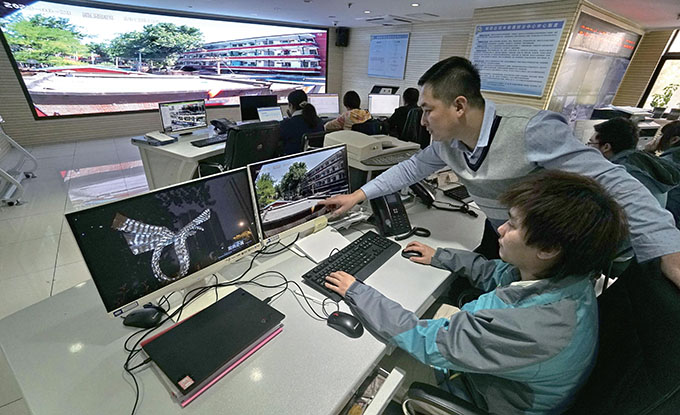
Staff use the city’s smart brain system to monitor community fire dynamics Xinhua News Agency/Photo courtesy
While enabling public services, digital technology faces risks such as data security and data abuse. The application of digital technology and the expansion of digital resources will not only improve the efficiency of public services, but also bring risks such as the disclosure of people’s private information and even government confidential information, the disorderly expansion of platforms and AI ethics, which puts forward new and higher requirements for government public services and daily supervision.
Although digital technology optimizes public services, it still has some limitations in solving institutional and root problems. From the practical point of view, some public service problems such as infrastructure construction, medical and educational resource allocation, floating population service, ecological environment management, social organization cultivation, etc. often need deep-seated interest adjustment, and some also involve institutional mechanism optimization, all of which need to make breakthroughs in management system and mechanism through continuous deepening reform, and digital technology plays a limited role at this level.
The uneven popularization and application of digital technology has led to the "digital divide" and the gap in public services in some fields. At present, the distribution and use of digital resources and technologies among various groups of people are uneven. Some elderly people, migrant workers, disabled people and people in need are limited by physical, cultural and economic conditions, and there are certain difficulties in mastering and using digital technologies, which affects the level of these groups enjoying public services.
The integration of digital elements is not high, which affects the efficiency of digital technology. The digital resources of public services are widely distributed among government departments, social organizations and clients. The digital resources are "isolated" and "fragmented" and lack of a unified digital integration mechanism, which directly affects the quality and efficiency of digital public services.
Faster speed, warmer temperature
The ultimate goal of digitalization is to expand various functions as much as possible, improve the level of public services with faster speed and warmer temperature, and constantly improve the people’s sense of happiness and security.
Improve the organizational leadership system and increase investment in digital technology. Further clarify the functions of relevant departments, optimize the responsibilities of the Big Data Bureau, improve data integration and service functions, and clarify the scope and rules of digital supervision. Increase the public budget and improve the level of digital infrastructure of public services. Promote intelligent upgrading and build an intelligent and efficient digital convergence infrastructure.
Break through the barriers of resource division and build a collaborative and efficient digital technology service system. Promote the construction of a digital public service system covering provinces, cities, counties, townships, villages and different departments, attract the participation of various subjects such as the government, the market, and the masses, establish a resource-sharing, multi-party collaboration, integrated and efficient digital service mechanism, and open up two-way feedback channels of "top-down" and "bottom-up" to form a precisely matched service supply model.
Strengthen standardization construction and improve the governance capacity of digital services. We will improve the digital technical specifications in public service objects, service contents and service standards, improve the digital standard specifications in key areas of people’s livelihood, and promote the standardization of public services with digital technical standardization. Strengthen digital technology training and continuously improve the digital service ability of public servants.
Cultivate multi-center subjects and promote the integrated development of digital products and services. Accelerate the development of smart government and social capital cooperation (PPP). Actively guide leading enterprises and social organizations in digital technology to participate in public services. Accelerate the transformation of new technologies from commercial products to public products. Promote the deep integration of digital technology and people’s livelihood security, focus on the "urgent difficulties and worries" of the masses, and actively carry out research and development of digital public service products.
Promote information equalization and improve the level of digital services for special groups. Narrow the gap between urban centers and suburban public services, improve citizens’ digital literacy and participation awareness, and provide more and fairer basic public services for more migrant workers and new citizens. Increase the education, training and publicity of digital technology, do a good job in popularizing digital technology for the elderly, floating population and people in difficulty, and constantly narrow the "digital divide."
Strengthen planning management and improve the empowerment effect of digital technology. Learn from the experience of urban governance in developed countries, integrate digital technology into urban development planning, and build a digital friendly city. Pilot digital public services in cities with a good foundation for digital economy development, and build a number of benchmark cities for digital public services. Timely track and evaluate the implementation effect of digital transformation of public services, and dynamically optimize the digital evaluation system of public services.