
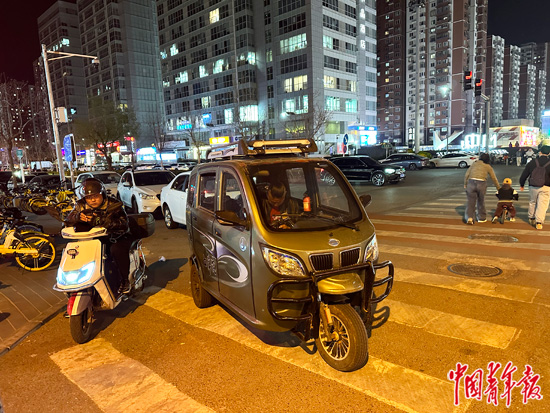
   Since January 1 this year, Beijing, Tianjin and other places have successively issued regulations requiring that low-speed three-and four-wheeled vehicles that do not meet the standards are not allowed to drive on the road, and they are not allowed to park in public places such as roads, squares and parking lots. Law enforcement departments will investigate and deal with them according to law. Wang Zhiyuan/photo
    In recent years, with the rapid development of economy, the scale of many cities has been rapidly expanded. "Commuting to work by subway is crowded, and it takes one kilometer to buy food" has become the epitome of many people living in large and medium cities. Faced with this situation, low-speed electric three-and four-wheeled vehicles with simple driving and low price (hereinafter referred to as "low-speed three-and four-wheeled vehicles") are regarded as the preferred means of transportation by some people.
    As we all know, low-speed three-wheeled and four-wheeled vehicles are also called "scooter for the elderly" and "old man’s joy". These titles reflect its attributes to a certain extent-to meet the "last mile" travel needs of consumers, especially the elderly, such as picking up children, shopping and walking.
    Undeniably, low-speed three-and four-wheeled vehicles have brought convenience to the elderly. However, due to its low safety technical standards and some drivers’ weak awareness of travel safety, the "old man’s joy" has caused obvious hidden dangers to the safety of roads, lives and property, and has also become a chronic disease in road traffic management in various places.
    In order to purify the road traffic environment and maintain the road traffic safety order, since January 1 this year, Beijing and Tianjin have successively issued regulations requiring low-speed three-and four-wheeled vehicles that do not meet the standards not to drive on the road and not to park in public places such as roads, squares and parking lots. If you drive or park on the road illegally, the law enforcement department will investigate and deal with it according to law. In addition, Jiangsu, Anhui and other places have also begun to supervise and restrict the low-speed three-and four-wheeled vehicles on the road through various means.
    With the improvement and management measures of low-speed electric vehicles introduced in many places, the legality and identity of these products on the road have once again become the focus of discussion and attention. "Why is’ Old Man Le’ banned from the road?" "How to develop low-speed three-and four-wheeled vehicles in the future?" "How to solve the travel problem of the elderly?" In view of the above problems, the reporter interviewed relevant experts and insiders and discussed them.
   Security issues may become "time bombs"
    Lin Xiao, a citizen of Beijing, was "furious" when he mentioned "the old man is happy". "I feel scared when I see this kind of car. When I drive normally on the road, I may encounter a low-speed three-or four-wheeled car that suddenly changes lanes, jams or goes backwards. At the same time, many drivers of low-speed three-and four-wheeled vehicles often park their vehicles indiscriminately, which not only occupies motor vehicle spaces, but even blocks the entrances and exits of residential areas and parking lots, making it impossible for other vehicles to pass normally. "
    Lin Xiao’s feelings are only a microcosm of the safety problems of low-speed three-and four-wheeled vehicles in various places. According to the data released by the Ministry of Transport, in recent years, there have been more than 830,000 traffic accidents involving low-speed electric vehicles in China, resulting in 18,000 deaths and 186,000 injuries. The number of accidents and the number of deaths caused have increased year by year. In Beijing alone, there were 131 traffic accidents caused by low-speed three-and four-wheeled vehicles in 2022, with 138 deaths.
    According to Zhang Xiang, a visiting professor at the Yellow River Institute of Science and Technology, traffic accidents of low-speed three-and four-wheeled vehicles have occurred frequently in recent years, not only because of "drivers’ weak awareness of traffic safety", but also because many low-speed three-and four-wheeled vehicles do not meet the relevant production standards and technical requirements.
    "The industry of low-speed three-and four-wheeled vehicles can be described as’ barbaric growth’ in the early stage of development, and some enterprises even have no production qualifications." Zhang Xiang told reporters, "Many low-speed three-and four-wheeled vehicles used to carry passengers or goods have no uniform standards and configurations in the safety fields such as braking, steering and collision, which leads to the low safety of such products, just like a flying’ time bomb’."
    As for the problem that low-speed three-wheeled vehicles have potential safety hazards, China Consumers Association once conducted a collision test, which simulated the frontal collision of three low-speed three-wheeled vehicles with the front barrier at a collision speed of 32km/h, and the results were staggering.
    The test results show that the dummy drivers driving the three test products are at risk of fracture in many parts such as skull, ribs and femur after being hit. It should be noted that the test speed of 32km/h is lower than the driver’s daily driving speed, so its danger is far less than that of traffic accidents of low-speed three-wheeled and four-wheeled vehicles in actual situations.
    There is no doubt that for drivers and passengers of low-speed three-and four-wheeled vehicles, or for motor vehicles and non-motor vehicles on the road, driving low-speed three-and four-wheeled vehicles that do not meet safety regulations and are barbaric and disorderly is like a dangerous "bomb". Therefore, it is urgent to rectify the travel problem of low-speed three-wheeled vehicles and standardize the production standards of low-speed three-wheeled vehicles.
    In November 2018, the Notice on Strengthening the Management of Low-speed Electric Vehicles (hereinafter referred to as the "Management Notice") jointly issued by the Ministry of Transport and other six departments clarified the concept of "low-speed electric vehicles" for the first time; In March 2019, the Ministry of Industry and Information Technology issued a mandatory national standard formulation plan for "Technical Conditions for Four-wheel Low-speed Electric Vehicles". The estimated completion date is 2021, but up to now, the plan has not yet been introduced.
    In June 2021, the Ministry of Industry and Information Technology announced the recommended national standard "Technical Conditions for Pure Electric Passenger Cars (Draft for Comment)" (hereinafter referred to as "Technical Conditions"), and revised and added the definition and standard of "mini low-speed pure electric passenger cars". It is clear that the miniature low-speed pure electric passenger car refers to a pure electric passenger car with four seats or less and a maximum speed of less than 70 km/h.
    In addition, the "Technical Conditions" put forward corresponding indicators and requirements for the outline size, vehicle kerb quality, post-collision safety, braking performance, stability, vehicle dynamic performance, power storage battery, signs and signs of micro low-speed pure electric passenger cars. For example, the length, width and height of the vehicle body should be no more than 3.5 meters, 1.5 meters and 1.7 meters respectively, and the curb weight of the vehicle should not exceed 750kg;. The speed of frontal collision test is 40 km/h; The energy density of the battery system should not be lower than 70Wh/kg, etc.
    In Zhang Xiang’s view, the relevant technical requirements of the newly-added miniature low-speed pure electric passenger car are of great significance to standardize the industry management of this type of car.
    On the one hand, the technology requires that the mini low-speed pure electric passenger car be turned into a subclass of pure electric passenger car, so that the relevant departments do not need to establish another set of management system separately, but can use the existing motor vehicle management system for management to the greatest extent, which is conducive to accelerating the follow-up standardized management work.
    On the other hand, the technical requirements not only provide a basis for management departments at all levels and local governments to clean up and rectify low-speed three-and four-wheeled vehicles, but also provide a reference for related enterprises to develop and produce standardized and compliant products, and point out the direction.
    Zhang Xiang told reporters that at present, all low-speed three-and four-wheeled vehicles that are produced without the permission of the Ministry of Industry and Information Technology and are not listed in the Announcement of Road Motor Vehicle Manufacturers and Products of the Ministry of Industry and Information Technology, and their vehicle performance does not meet the technical standards for motor vehicle safety, cannot apply for licenses and cannot legally drive on the road.
    "The introduction of a series of guidance documents means that the low-speed three-and four-wheeled vehicle industry will be forced to upgrade from the production end-manufacturers need to have certain R&D and production capabilities, vehicles must be licensed, and drivers must also hold driver’s licenses … This will effectively control the chaos in the low-speed electric vehicle industry to a great extent, which will help reduce related safety hazards and improve urban traffic conditions." Zhang Xiang concluded.
   Industrial transformation and upgrading need to be promoted by many parties.
    Although up to now, there have been guiding documents and policies on the manufacturing and daily travel of low-speed three-and four-wheeled vehicles one after another, the relevant mandatory national standard for low-speed electric vehicles has been delayed, which is caused by the differences of opinions among the competent authorities, the automobile industry, low-speed electric vehicle enterprises and market demand.
    After the reporter inquired, it was found that the "Management Notice" made it clear that the clean-up and rectification of low-speed electric vehicles would start from the production and sales enterprises and be implemented in three stages.
    In the first stage, it is necessary to find out the basic situation of low-speed electric vehicle manufacturers; The second stage is the rectification stage. For enterprises found in the previous stage, which borrowed the license from the Announcement of Road Motor Vehicle Manufacturers and Products, or produced and sold low-speed electric vehicle products beyond the scope in the name of special vehicle production license, they should be rectified, and enterprises without business licenses should be banned and sealed up according to law.
    In the third stage, according to the technical standards and policy spirit, relevant departments formulated and implemented a special plan to clean up and rectify low-speed electric vehicles, and took comprehensive measures to clean up substandard production enterprises according to law. It is strictly forbidden to produce and sell low-speed electric vehicles without permission and without compulsory product certification.
    At the same time, in the third stage, relevant departments at all levels also need to guide qualified low-speed electric vehicle manufacturers to produce road motor vehicle products that meet relevant standards through transformation and upgrading or integration and reorganization with existing motor vehicle manufacturers.
    It should be noted that in addition to cleaning up and rectifying the existing production capacity, the "Management Notice" also prohibits new production capacity of low-speed electric vehicles, and better manages low-speed three-and four-wheeled vehicles by means of "opening the flow and saving resources".
    According to the statistical data of China Low-speed Electric Vehicle Industry Development Analysis and Investment Prospect Research Report (2024-2031), from 2015 to 2017, the annual output of domestic low-speed electric vehicles approached and exceeded 1 million, showing a growing trend. In 2018, affected by the policy, the production scale of low-speed electric vehicles began to shrink. Since then, affected by the hot sales of A0-class electric vehicles such as Wuling Hongguang MINIEV, the output of China low-speed electric vehicle industry has rebounded slightly, with the output of about 335,000 vehicles in 2021.
    Under the pressure of the ban, the process of retiring the "old man music" in various places has accelerated. In this case, some low-speed three-wheeled and four-wheeled vehicle manufacturers began to transform and upgrade and actively save themselves.
    "For most low-speed three-and four-wheeled vehicle manufacturers, there are problems of’ high technical threshold’ and’ awkward product positioning’, which make it difficult for them to compete directly with passenger car companies, and it is possible to gradually lose the user groups with the demand for transportation." Zhang Xiang bluntly said that the transformation of low-speed three-and four-wheeled vehicle manufacturers is not an easy task.
    Previously, in 2018, Reading Automobile, known as "the old man is happy as a brother", successively acquired Shaanxi Qin Xing Automobile and strategically reorganized Mustang Automobile, so as to formally obtain the production qualification of new energy vehicles, fuel passenger cars and buses.
    Subsequently, Redding tried to complete the brand transformation and upgrading through I series products (pure electric mini-car Redding i3, pure electric mini-car Redding i5 and pure electric SUV Redding i9). However, after the launch of I series products, the market response was not good, and the related models were completely discontinued only one year later. In the end, Reading Automobile, which failed in transformation, declared bankruptcy in May 2023 and left in a daze.
    On the one hand, under the rules and prohibitions, low-speed three-and four-wheeled vehicle manufacturers are struggling to explore transformation; On the other hand, with the increasingly strict management of low-speed three-and four-wheeled vehicles, the problem of "last mile" for the elderly has attracted more and more attention.
    Statistics show that by the end of 2023, the number of elderly people over 60 in China reached nearly 300 million, accounting for 21.1% of the total population; The number of elderly people over 65 reached 210 million, accounting for 15.4% of the total population. With the aging population and the development of silver-haired economy, ensuring the travel needs of the elderly has become an issue that cannot be ignored.
    In Zhang Xiang’s view, the problem of short-distance travel of the elderly should not only attract enough attention, but also be reasonably satisfied. However, it is by no means a reasonable plan to let the "old man music" go on the road at will. He believes that in the future, China’s low-speed electric vehicle industry will continue to be influenced by many factors such as policies, technology and market demand, and will continue to develop and transform in the throes.
    He said: "In the face of diversified traffic conditions, it is necessary not only to guide low-speed three-and four-wheeled vehicles through corresponding policies, but also to upgrade their industries. The simple desire of people to travel conveniently needs to be realized on the basis of traffic safety management. "
    Zhang Xiang believes that on the one hand, innovations in battery technology, electric drive system and intelligent control system can improve the battery energy density and extend the cruising range of low-speed three-and four-wheeled vehicles; On the other hand, how to obtain legal licenses for low-speed three-wheeled and four-wheeled vehicles, how to obtain driver’s licenses and how to cultivate safe driving awareness still need to be further clarified.
    "But with the development of China’s’ new four modernizations’,’ Old Man Le’ will become an obstacle to the development of urban smart transportation in the future." Zhang Xiang reminded that it is a social governance goal to let low-speed three-and four-wheeled electric vehicles that do not meet the standards withdraw from urban roads sooner or later. He believes that with the continuous promotion of new energy vehicles to the countryside, low-speed three-and four-wheeled vehicles will gradually be replaced by A0-and A00-class new energy vehicles. (Trainee reporter Wang Zhiyuan reporter Zhang Zhenqi)