
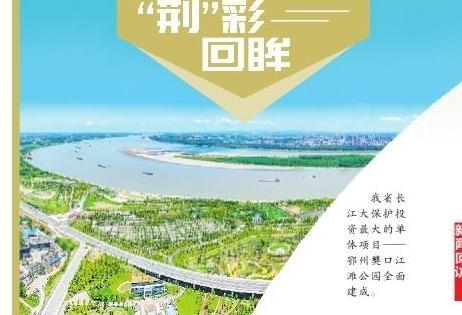
The single project with the largest investment in Yangtze River Protection in our province-Ezhou Fankou Jiangtan Park was fully completed.

On January 30th, the national first-class protected animal black stork was framed with the Tianxingzhou Yangtze River Bridge in Wuhan, and the ecology of Tianxingzhou in Wuhan continued to improve, welcoming the black stork in winter every year.
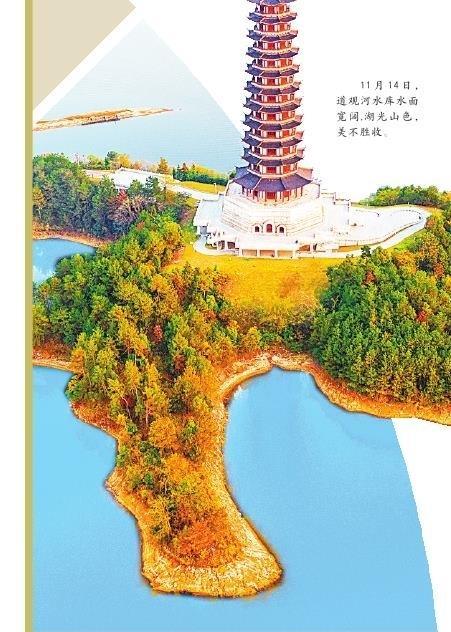
On November 14th, the Daoguanhe Reservoir had a wide water surface and beautiful lakes and mountains.
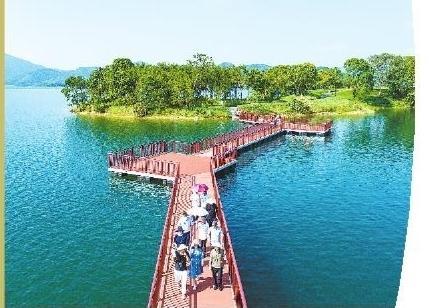
On August 4th, Niuche River Basin in Tuanfeng County, Huanggang has a clear shore and pleasant scenery.
River basin management
Harnessing Jingchu must first harness water. At the beginning of this year, the Outline of Comprehensive River Basin Management and Overall Development Planning in Hubei Province was issued, which became the latest guideline for Hubei to coordinate high-quality development and high-level protection.
"Planning Outline" puts forward that Hubei should keep the bottom line of water environment safety, ensure that the environment of rivers and lakes does not deteriorate, and the proportion of excellent water quality in rivers and lakes does not decrease, eliminate inferior V water bodies and ensure the water quality safety of drinking water sources.
Taking the comprehensive management of river basins as the breakthrough point, the province has broken through the traditional concept of territoriality, changed the management mode with administrative boundaries as the core in the past, adhered to the overall planning of river basins, unit control, bottom line guarantee and system balance, and coordinated the factors such as left and right banks, upstream and downstream banks, water and shore, so as to effectively carry out the source management and the restoration of landscape, forest, fields, lakes and grass systems, and create a development space where people and nature can live in harmony.
He who does not seek the overall situation is not enough to seek a domain. Overall planning, systematic governance, coordinated implementation and global promotion, Hubei will actively change its production and lifestyle, promote the coordination of population, resources and environment, promote the value transformation of ecological areas, and realize the harmonious coexistence between man and nature.
News return visit
Small aquatic plants have made great contributions to the province of thousands of lakes
On December 20th, liangzi lake Niushazui Island, the winter lake wind was biting. The only place that this cold wind can’t blow is the greenhouse of liangzi lake National Field Science Observation and Research Station of Wuhan University. Here, the national first-class protected wild plant-water plantain has small white flowers.
"After a year of fencing and planting grass, the water quality in liangzi lake has been effectively improved. In summer, precious water plantain has grown in some lake areas. This plant has extremely high requirements for water quality and only lives in clear water with bottom transparency." Yu Dan, the stationmaster of the research station and a professor at the School of Life Sciences of Wuhan University, introduced that the water plantain that had not appeared in liangzi lake for 8 years was found, and the teachers and students of the research station were so blessed that they carefully transplanted it into the greenhouse for cultivation and observation. Everyone expects that in the future, Liangzi Lake will not only have grass all year round, but also bloom all year round.
In April this year, Hubei Daily published "Keeping Dan’s Heart in the Deep Lake" and a series of reports. Readers were deeply moved by Yu Dan’s spirit of seeking for more than 30 years. Now, with the comprehensive management of river basins as the key link, teachers and students in Yudan continue to go green and explore new ways to manage lakes such as liangzi lake, Jinhu and Honghu.
From purse seine fish farming to purse seine grass planting.
In the province of thousands of lakes, many lakes are divided by the siltation of ancient Yunmengze. With the increase of population and the shortage of supply, it has become a common phenomenon to cultivate land around lakes. Perennial aquaculture has led to mild pollution of the overall water quality of major lakes in the province, and the main pollution indicators are total phosphorus and chemical oxygen demand.
In order to keep the bottom line of water environment safety, industrial production was retired around liangzi lake, and the lake area withdrew from purse seine farming. For decades, teachers and students Yu Dan planted 200,000 mu of aquatic plants at the bottom of liangzi lake. The dense growth of "underwater forest" has played an important role in restoring ecology and purifying water quality. Liangzi lake has become the only lake in the middle and lower reaches of the Yangtze River that maintains the first-class water quality.
In 2020, liangzi lake encountered a new ecological problem-a large number of fish in the lake swallowed up aquatic plants, and the former "underwater forest" became an "underwater desert". Due to the high density of fish and more excreta, the water quality was deteriorating. Yu Dan called on relevant departments to take effective measures as soon as possible and continue to try new ways to plant grass in the lake.
"Because fish will interfere with the growth of aquatic plants, in order to improve the survival rate as much as possible, we drive fish in the lake purse seine and plant grass in the net." According to Yu Cheng, a lecturer at the research station, seven batches of grass seeds and seedlings have been planted in the purse seine this year, and the water quality has been greatly improved. Some purse seine areas even have second-class water quality.
From ecological beauty to people’s wealth
In winter, Niushazui Island is very quiet. Wearing a wool hat, 66-year-old Yu Dan still insists on patrolling the lake every day, thinking about the new direction of lake management.
"The area of the liangzi lake River Basin is about 7 times that of the lake. If you want to manage the lake well, you must think globally with the basin." Yu Dan said that liangzi lake has 99 lakes and bays and a 606-kilometer-long coastline, so we should adhere to the idea of integrating water and shore and treating the upstream and downstream together. Keeping the coastline is the "Macedonian defense line" to keep the water environment of the lake safe.
At the suggestion of Yu Dan, in the second half of this year, Ezhou started the 100-meter fish pond near the lake in liangzi lake to completely withdraw from the breeding function. "The lake is 100 meters away, which is the ecological buffer zone of liangzi lake. Traditional farming and feeding bring pollution. Only by minimizing the pollution into the lake can we better care for liangzi lake." Cai Helin, secretary of the liangzi lake District Committee of Ezhou City, said that it is estimated that by January next year, 13,000 mu of fish ponds within 100 meters of the lake will all be out of breeding function.
After retirement, these fish ponds will also be planted with aquatic plants under the guidance of teachers and students Yu Dan, and further develop the aquatic plants industry. "Through investigation and judgment, the average output value per mu of aquatic plants industry is expected to be higher than that of traditional fish farming." Cai Helin introduced that when aquatic plants are planted, industries such as "aquatic plants+freshwater shrimps" and "aquatic plants+crabs" can be developed in the fish pond, which can create new income growth points for villagers around liangzi lake within two years, find the path of value transformation of ecological products, and truly realize the ecological beauty, industrial prosperity and people’s wealth required by comprehensive river basin management.
From one lake to more lakes
Starting from liangzi lake, Yu Dan’s team used the increasingly mature experience of aquatic vegetation restoration to benefit more lakes in Hubei.
At the end of October this year, the state announced the first batch of 15 typical cases of integrated protection and restoration projects of mountains, rivers, fields, lakes, grass and sand, and the ecological restoration project of Jinhu Wetland in zhijiang city, Yichang was successfully selected. This achievement is inseparable from the long-term presence of Yu Dan’s team in the management of Jinhu.
Jinhu is the largest lake in zhijiang city. Due to long-term high-density aquaculture, the water quality has deteriorated to five categories, and cyanobacteria blooms have occurred from time to time. In 2018, the research station was invited to provide technical support for the ecological restoration of Jinhu. Without dredging and planting grass scientifically, stagnant water can be "alive".
Fan Shufeng, a lecturer at the research station, said that some black algae, Sophora alopecuroides, Ceratophyllum, Potamogeton crispus, and water lilies are born in autumn and winter, some are long in spring and summer, some are pioneers-they quickly survive and occupy positions, and some continue to exert their strength-they absorb both nitrogen and phosphorus and floating stains. Over the past five years, more than 20 species of aquatic plants have been restored in Jinhu, with a total area of 430 hectares, and the water quality has been upgraded to four categories. Jinhu, from the "fishy pond" in the past, has changed into a beautiful scenery with shallow fish and thousands of birds.
At the same time, Yu Dan’s team has completed the investigation and scientific evaluation of Honghu Lake, and put forward specific technical schemes for water purification and aquatic vegetation restoration. "The water level of Honghu Lake is low, and the elements such as nitrogen and phosphorus in the water are high. The mud in the lake is deep and suitable for the growth of aquatic plants." Yu Dan suggested that large lakes, such as Honghu Lake, can develop aquatic plants industry and achieve balanced ecological protection and economic development.
Treatment of small watershed in Xihe Road, Dongbao Pailou
Pits and ponds become wetlands, and water storage adds scenery.
story
On December 20, Pailou Village, Dongbao District, Jingmen City, although it was a cold winter, the lotus pond on the roadside was still beautiful. Lotus leaves stand, lie down, or lie down, the breeze blows gently, rustling, and the poetic scene of "leaving the residual lotus to listen to the rain" comes naturally.
"This is an artificial wetland, which was transformed from 7 pits and ponds." Chang Wei, a member of the Party Group of Dongbao Ecological Environment Branch, said that the wetland covers an area of 104 mu, which used to be a muddy land. After the village collective transferred from the villagers at the annual rent of 600 yuan per mu, it cooperated with the market participants to plan and design centrally, and planted lotus flowers and aquatic plants after dredging, which not only stored and preserved water, but also created a landscape.
In April this year, the provincial party committee confirmed the pilot projects of comprehensive management of five small watersheds, including Maojian District of Shiyan City-Maotahe River in Economic Development Zone and Yangloudong Port in chibi city City of Xianning City, in which the Pailou Xihe River was included.
Pailou Xihe River is a pocket river with a total length of 12.4 kilometers. There is little precipitation in autumn and winter, large water consumption and serious seasonal water shortage in the basin.
It is the key to keep water and water in order to moisten the water-deficient river. Fang Wenjuan, a member of the party group of Dongbao District Water Conservancy and Lakes Bureau, introduced that there are 170 pits and ponds along the Xihe River in Pailou, with a total area of 1,162.5 mu, some of which are abandoned and some are used for aquaculture. According to the plan, 125 pits and ponds were restored into paddy fields for planting rice; There are 44 pits and ponds within 200 meters of the river, with a total area of 428 mu, 16 of which have been transformed into artificial wetlands and 28 have been dredged into reservoirs. By the end of this year, all the wetlands and reservoirs have been rebuilt.
"Wetlands are interconnected with reservoirs and rivers, which not only receive rainwater, but also purify water quality, killing two birds with one stone." Chang Wei introduced that the government is planning to introduce social capital, give preferential policies, and guide villagers to participate in the operation and management of wetlands through joint efforts.
Walking into the village of Xingjiayuan, Changxing Village, Pailou Town, the villagers’ official water forest is watering vegetables in the vegetable garden, and a newly dredged pit not far away has been filled with water. "The water source is sufficient, so there is no need to grab water for watering vegetables." Guan Shuilin said with deep feelings.
Transformation from "Phosphorus Capital" to Fine Chemical Industry such as Iron Phosphate
One step more processing, double the price
On December 18th, in the workshop of the newly-built 50,000-ton iron phosphate project of Zhongyangfeng Middle Phosphate Fertilizer Company in Zhongxiang City, machines roared, and workers checked equipment and recorded data from time to time.
"The production of iron phosphate is a fine chemical industry, which is very different from the traditional phosphorus compound fertilizer. One indicator that fails to meet the standard is waste." Hu Mingfeng, the project leader, said.
Zhongxiang has the reputation of "Phosphorus Capital in Central China", but low-level processing wastes resources and pollutes the environment.
Last year, Xinyangfeng took aim at Jingmen as the largest lithium battery production base in Central China and the advantage of large demand for iron phosphate, and cooperated with Changzhou Lithium Source, Gemei and other companies to launch iron phosphate production projects first.
In April last year, the first set of 50,000-ton iron phosphate project of Xinyangfeng Zhongphosphorus was completed and put into operation, becoming the first set of 50,000-ton iron phosphate production line in China. In May this year, another 50,000-ton iron phosphate project was put into production. The company also has 100,000 tons of iron phosphate project under planning and construction.
"A ton of iron phosphate sold for 20,000 yuan at the highest time, and now the price has fallen and sold for more than 10,000 yuan." Hu Mingfeng introduced that the raw material for producing iron phosphate is phosphate monoammonium phosphate, with a market price of 5,000 yuan per ton. After being processed into iron phosphate, the price immediately doubled. At present, the company has produced 55,000 tons of iron phosphate with a total output value of more than 700 million yuan. Phosphorus in Xinyangfeng is one step ahead, followed by enterprises such as Hubei Central Ecology and Shilong Chemical. The planned project of Zhongxiang Iron Phosphate is 400,000 tons.
In addition to new energy materials, Xinyangfeng Zhongphosphorus has also launched food-grade phosphoric acid and anhydrous hydrogen fluoride projects to eat and squeeze out the associated resources of phosphate rock.
"Food-grade phosphoric acid is 20 to 30 times more profitable than phosphorus compound fertilizer." Wang Baoan, the person in charge of the project, said that the new project has high technical level, low pollution and high profit rate, which has directly improved the competitiveness of enterprises.
In huji town, the "heart" of phosphorus capital, the number of phosphorus chemical enterprises decreased by 9 compared with 2016. However, enterprises represented by phosphorus in Xinyang and ecology in central Hubei accelerated their transformation, and the industrial added value of the whole town increased by 17.3% annually. The annual output value of the three key enterprises totaled 10 billion yuan.
Number theory
culture and tourism
January to November 2023
First-class river basins in Hubei Province
-The water quality of the main streams of the Yangtze River, Hanjiang River and Qingjiang River continues to be excellent.
The water quality of some sections of Qingjiang River has reached Grade I.
The total phosphorus concentration in the Yangtze River continues to decrease.
January to November 2023
Among the 16 secondary river basins in the province, except for the Sihu area.
The water quality of 15 areas is excellent.
Among them, the water quality of 12 areas is excellent.
The water quality in southeastern Hubei and Tangbaihe areas is improving.
In 2023
Surface water in the whole province
The proportion of water reaching or better than Class III reaches 95.8%.
Township domestic sewage treatment facilities to achieve full coverage.
Realize "One Qing Jiang Water Flows to the East" and "One Reservoir of Clear Water Delivers to the North"
By promoting soil erosion control and ecological small watershed construction
Hubei ecological security has been systematically enhanced.
The province has established 46 nature reserves at or above the provincial level.
There are 64 important wetlands and 35 scenic spots.
Delineate 7 priority areas for biodiversity protection.
46 key ecological function districts and counties
The forest coverage rate reached 42.3%
Text of this edition:
Hubei Daily All-Media Reporter
Hu xian Zhu Hua
reporter
Li Bin Ouyang Ping Zhou Yong
This edition of the picture:
Hubei Daily All-Media Reporter
Zhu Xiyong Xue Ting Ren Yong
Chart: Xu Yun

关于作者