
The original Daisiyu Singularity Network is included in the collection # 5 Microorganisms.
* For medical professionals only.


Does the blood microbiome really exist?
Although for a long time, we all thought that blood was sterile, some studies in recent years have found that there are actually many kinds of microorganisms in healthy people’s blood besides septicemia and other diseases.
So can it be said that there is also a so-called "blood microbiome" in blood? Will it become a healthy new wind direction like "intestinal microorganisms"?
A recent study published in Nature Microbiology put an end to this problem. Scientists sequenced the blood samples of 9770 healthy people, and found that a small number of microorganisms in the blood mainly came from symbiotic bacteria in other organs, and most of the samples were completely sterile, and it was impossible to detect the symbiotic mode between different strains and their relationship with the host phenotype.
In other words, there are microorganisms in the blood, but they are just passers-by, and there is no "indigenous people" in the blood.
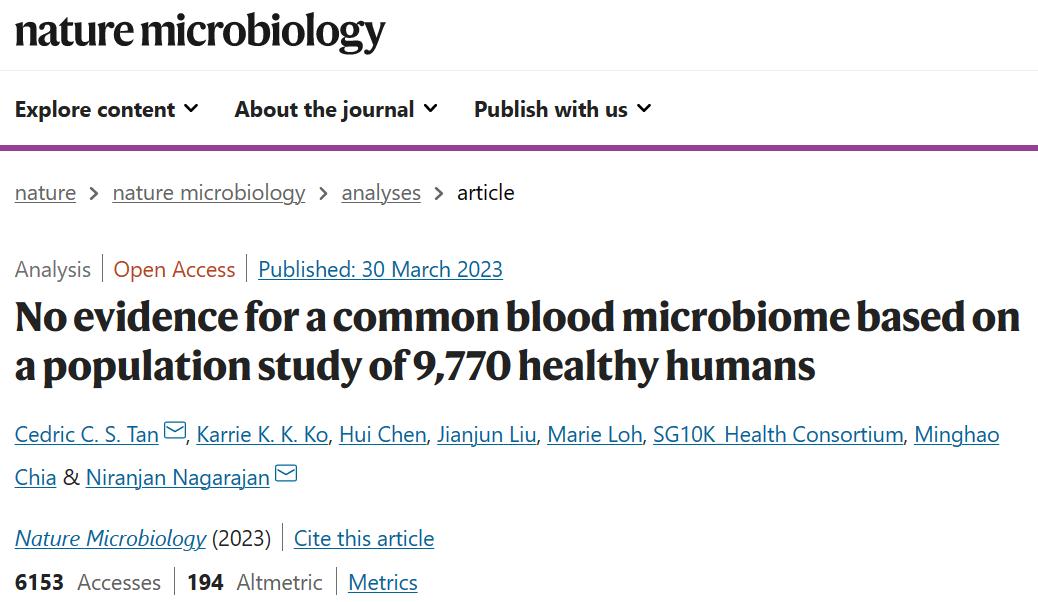
Thesis title map
First of all, we need to be clear about what "microbiome" means. Can be called "group", then these microorganisms should have some interactions with each other and the environment in specific niches, such as the mouth and intestines. Moreover, there may be core microbial species, that is, high-frequency species that occur between different individuals, such as Staphylococcus epidermidis in human skin microbiota.
Can microorganisms that meet these rules be found in the blood?
The researchers conducted the largest blood sequencing analysis to date on blood samples of 9770 healthy participants from six different cohorts. Of course, there are far more human DNA than bacteria in these data, so it is also very important to process them in advance. Only by excluding human DNA data, sequences with unknown classification origin, samples with low reading rate and various quality control methods can we get data that can be used for analysis.
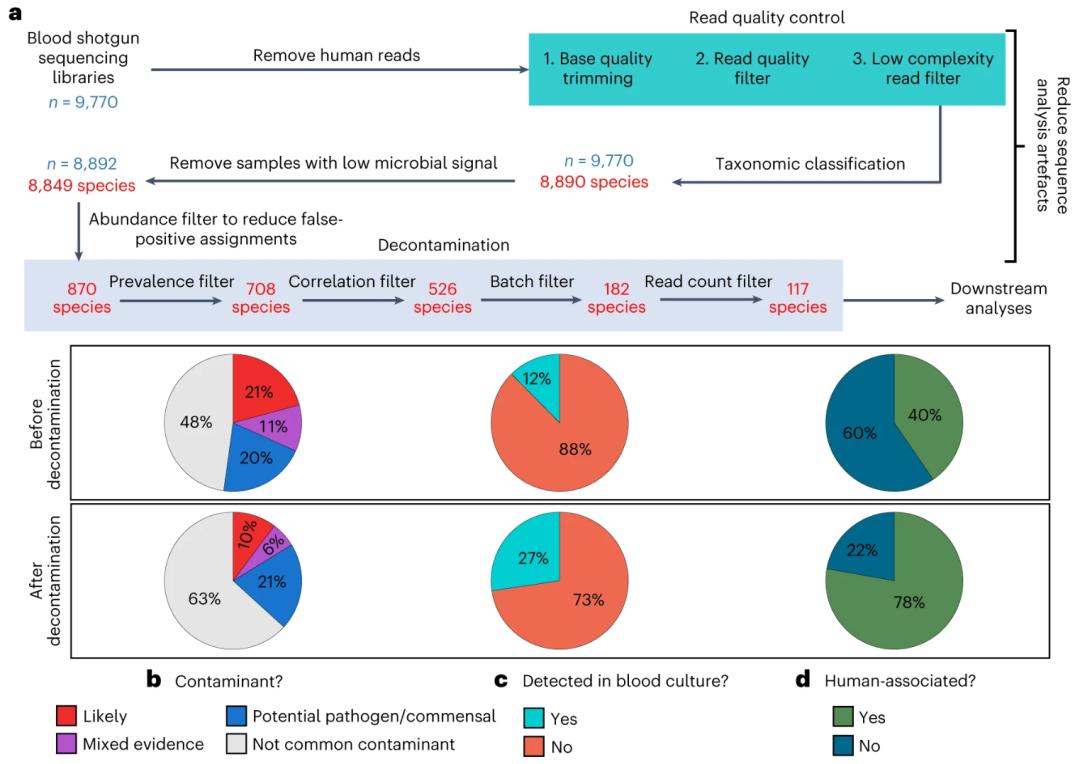
Screening process
Finally, the researchers detected 117 kinds of microorganisms in 8892 samples that met the standards, including 110 kinds of bacteria, 5 kinds of viruses and 2 kinds of fungi.
Among these microorganisms, the most common one is Cutibacterium acnes, but it exists in only 4.7% of the samples, which shows that the "core species" can be abandoned.
In fact, no microorganism was detected in 82% of the samples, and only one microorganism was detected in the remaining 18% of the samples. Although the microbial readings in some samples judged to be non-microbial can reach as high as 2.1 million reads, these samples are finally classified as pollutants.
The above results can fully explain that the existence of microorganisms in the blood of healthy people is extremely rare.
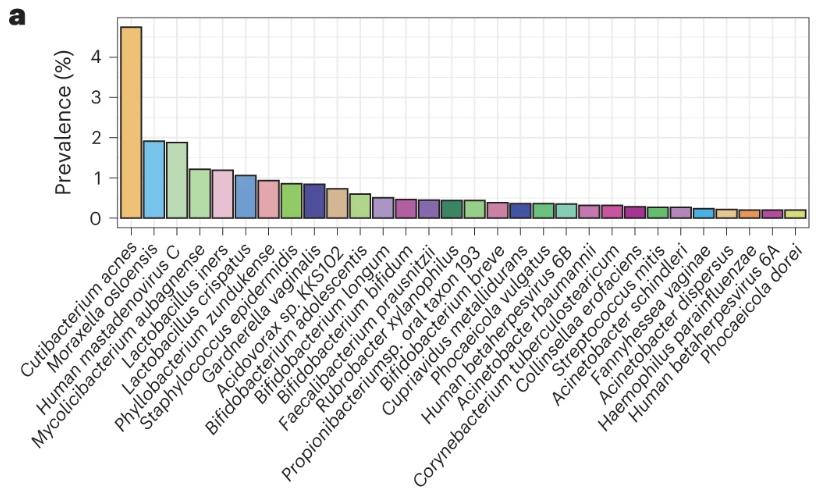
The prevalence of detected species is very low.
After consulting Disbiome, the database of microbial composition in diseases, the researchers found that about 50% of all 117 kinds of microorganisms are actually symbiotic strains from other parts of the human body, and about 36% are obligate anaerobic bacteria or obligate intracellular microorganisms, which may have been introduced during blood collection.
Combined with the low prevalence rate of these microorganisms, the researchers believe that these data are enough to show that the microorganisms in the blood are exogenous and enter the blood sporadically.
The researchers also analyzed the interaction between microorganisms, and found no common correlation in other microbial groups.
Finally, the researchers analyzed 117 kinds of microorganisms and eight host phenotypes recorded during blood collection, including gender, race, age, BMI, total cholesterol, triglyceride, systolic blood pressure and diastolic blood pressure. As a result, none of them showed the relationship with the existence of specific microorganisms.
Of course, this study in healthy people only shows that there is no permanent "blood microbiome" in healthy people’s blood, and there may still be special blood microbial communities for cancer or chronic diseases.
References:
[1]Tan, C.C.S., Ko, K.K.K., Chen, H. et al. No evidence for a common blood microbiome based on a population study of 9, 770 healthy humans. Nat Microbiol (2023). https://doi.org/10.1038/s41564-023-01350-w


The author of this article is Si Yu.
Read the original text

关于作者